

What Worked in the 2022 Bear Market?
- Subscribe to my YouTube Channel HERE.
A Bear Market is coming.
Everyone seems to agree...and the stock market has begun to fall.
The only thing people can't decide on is how bad it's going to get.
Is it the Dot-Com Crash all over again? Will it be like the Great Financial Crisis of 2008?
Or have things changed?
For example, will this next Bear Market be more like it was earlier this year? There was a fast, hard drop from February to April this year that no one seems to remember.
Or will it be something in between?
Maybe the next crash won't be for three years like the Dot-Com crisis and maybe it won't be a 50% drop like the housing crisis.
Maybe it will just be a hard slog -- like it was in 2022.
We're reminded by famous people that saying "it's different this time" is a stupid thing to do.
But it is different this time, isn't it?
The markets are totally affected by social media. This wasn't the case in 2000 and 2008.
Markets are 24 hours now in many cases. Again, this wasn't true in 2000 and 2008.
And the government is much more involved. The stock market feels like a marketing ploy these days, and actions are immediately taken on big drops.
Yes, it's dangerous to blindly think "it's different this time", but are we still sending faxes to do business?
Of course not.
We do it differently now.
Just like the millions of people on Robinhood are trading in a way that's radically different than getting quotes in Investors Business Daily newspaper or The Wall Street Journal (like we all still did in 2008).
It seems like 2022 is a better approximation of the next Bear Market, not the three-year Armageddon we saw from 2000-2003.
In fact, in the past 17 years, all the pullbacks look similar.
2011 looks like 2015, which looks like 2018, which looks like 2020, 2022, and 2025:
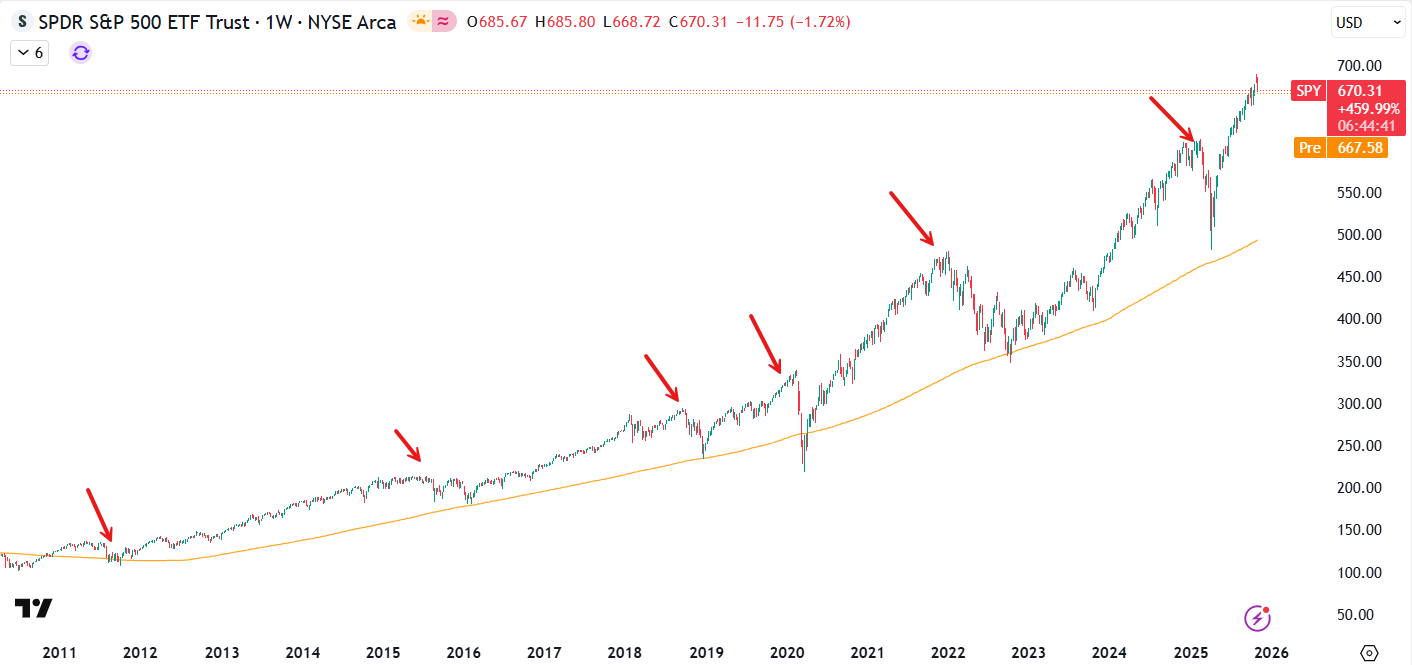
Looking at that chart, in the past two decades, 2022 actually looks like the worst one. Right?
So, if we want to see what might work in the next Bear Market, looking at '22 is not a bad idea.
And what worked back then?
We don't need to look any further than the Performance Page Portfolio (PPP). This portfolio, as you know, has four automated trading systems that hopefully all work together.
We have momentum and two forms of pullback trading. And we have Gold (which tends to do well when the market doesn't).
I track the PPP every month on my website, and I show results going back to 2016. Here are the Annual Returns:
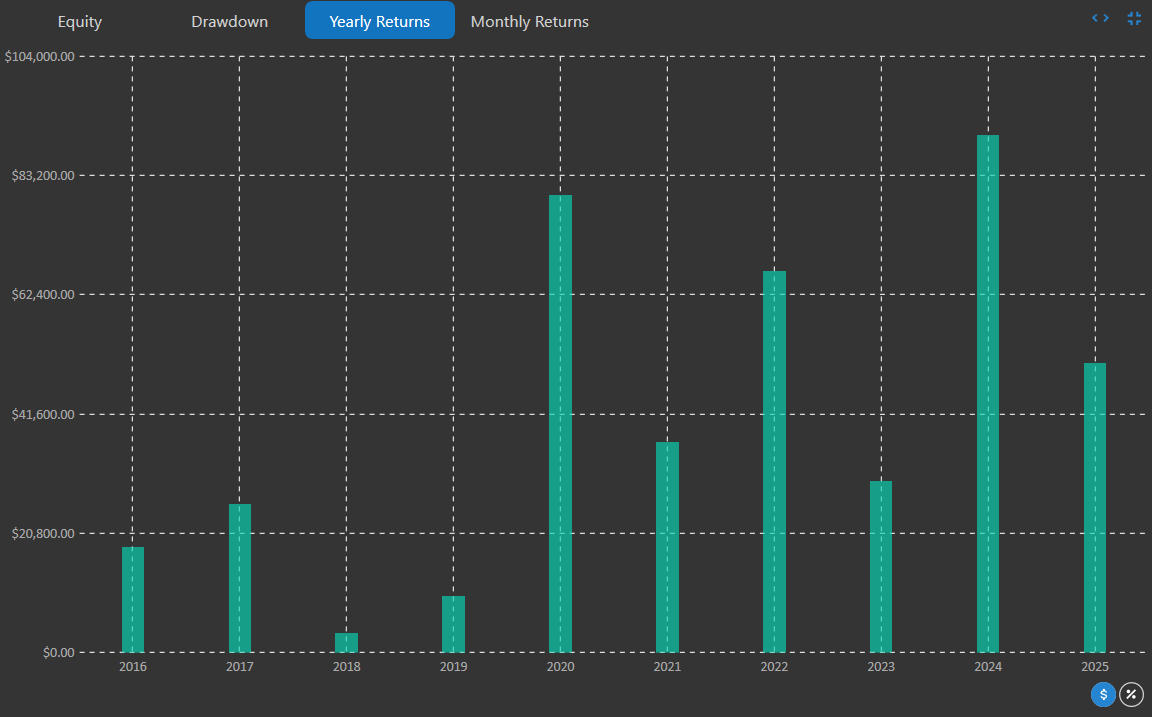
As you can see, there have been no losing years since 2016.
And, crazily, this portfolio actually thrived in 2022, showing a hypothetical profit of around $66k on a sample portfolio of around $60k (trading 1 contract each time).
Why would this be?
It's because every single system in the portfolio made money during 2022's Bear Market.
But if you're not comfortable trading automated systems because of all the obstacles that come with that form of trading and/or you're not familiar with Futures, is there anything else that might work in a Bear Market?
Yes. But some options are better than others.
You could trade an inverse fund. These gain in value when the market falls. The problem is that the market rises 75% of the time, so an inverse fund is pretty much a guaranteed loser over time.
No, what should work better is dividends.
Dividends don't fall as much during hard times because they're defensive in nature and pay out even when the market is cratering.
An example of this is RDIV. It trades the "best" stocks with high-yields in the S&P 900. How did it do in 2022?
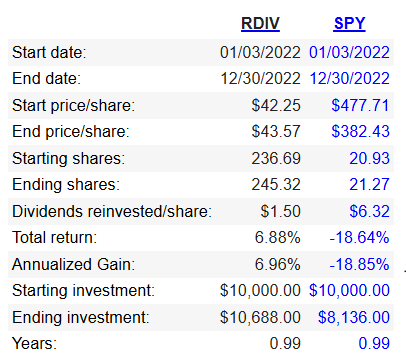
It beat the market by a wide margin.
And RDIV has done well overall, too, producing a total return from 2022-now of 42.6%.
What might work in the next Bear Market? Systems that are designed to work together in various market environments.
Or instruments that are designed to pay out money even when the world is on fire.
Those are great places to look.
Talk to you soon.
DISCLAIMER: This is not financial advice.
It should not be assumed that the methods, techniques, or indicators presented in these videos will be profitable or that they will not result in losses. Past results are not necessarily indicative of future results. Examples presented are for educational purposes only. These set-ups are not solicitations of any order to buy or sell. The authors, the publisher, and all affiliates assume no responsibility for your trading results. There is a high degree of risk in trading. HYPOTHETICAL OR SIMULATED PERFORMANCE RESULTS HAVE CERTAIN INHERENT LIMITATIONS. UNLIKE AN ACTUAL PERFORMANCE RECORD, SIMULATED RESULTS DO NOT REPRESENT ACTUAL TRADING. ALSO, SINCE THE TRADES HAVE NOT ACTUALLY BEEN EXECUTED, THE RESULTS MAY HAVE UNDER- OR OVER-COMPENSATED FOR THE IMPACT, IF ANY, OF CERTAIN MARKET FACTORS, SUCH AS LACK OF LIQUIDITY. SIMULATED TRADING PROGRAMS IN GENERAL ARE ALSO SUBJECT TO THE FACT THAT THEY ARE DESIGNED WITH THE BENEFIT OF HINDSIGHT. NO REPRESENTATION IS BEING MADE THAT ANY ACCOUNT WILL OR IS LIKELY TO ACHIEVE PROFITS OR LOSSES SIMILAR TO THOSE SHOWN.

