

RRS: Can We Retire With One ETF?
- Subscribe to my YouTube Channel HERE.
As I've mentioned before, I've been trading in one form or another since 2004.
And I've been writing this free Newsletter since 2013.
I've talked about a lot of instruments and a lot of systems.
Then Forex let me down and our financial lives have changed dramatically as a result. Was it a waste?
Not at all.
It all has led to this. (And what's to come.)
In last week's Newsletter, I said we're going to start talking about real ways to really retire.
Now, I don't believe in retirement. I think it's a bad idea.
But I do believe in financial independence. And that's what this Newsletter -- and many others to follow -- are going to talk about.
So today we're going to start going deeply down that path.
The ultimate goal is to find safe ways to take out $5k per month. I think that's reasonable. Additionally, I would love to hear from as many people as possible that are already at a point where they can take out $5k each month with no worries.
Here are my general ground rules for the Real Retirement Series (RRS):
- I want the process to be as simple as possible.
- Any system or ETF has to have been around for at least one year. Unfortunately, many companies are rushing to throw out "new" income ETFs to try to get those AUM fees. Sadly, a lot of these have turned out to be pretty awful. So, to get around this, we need at least one year of data or we will throw it out.
- Either through growth or dividends/distributions, we want to be able to pull out $5k (or more) while keeping the original nest egg at the original amount. Of course, if the nest egg grows, even better.
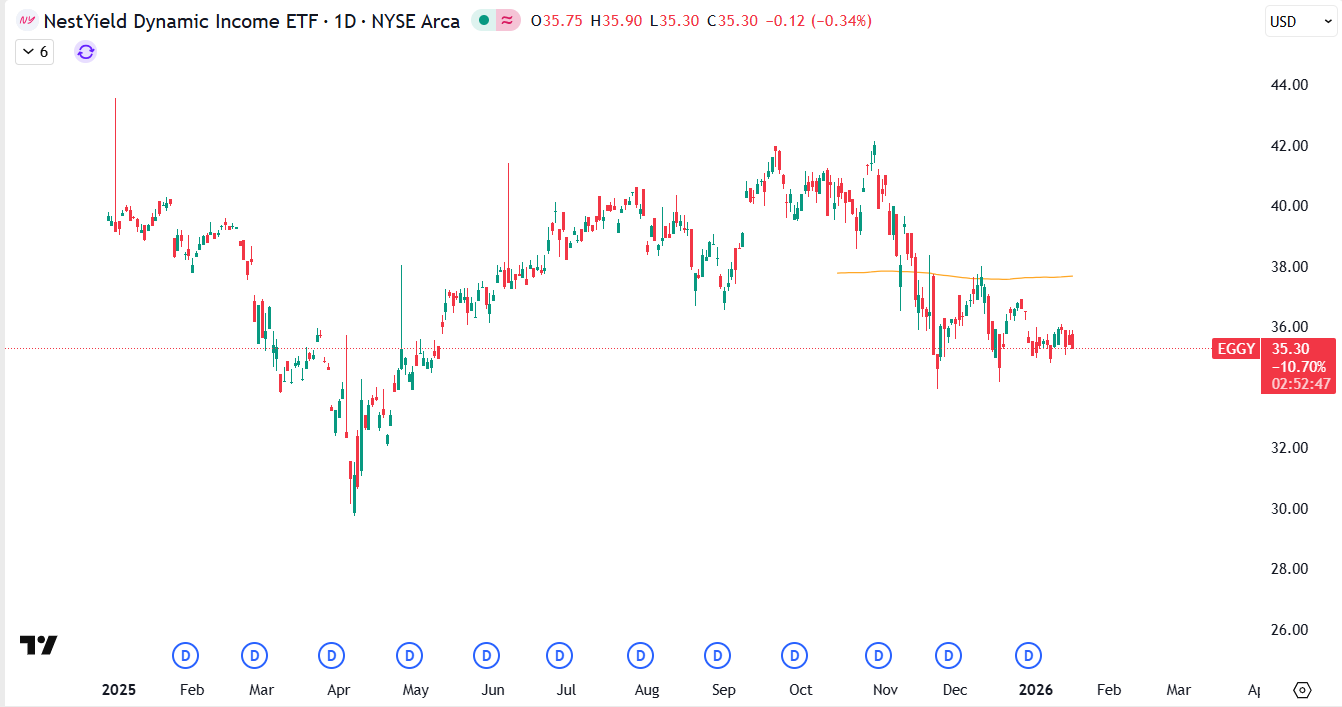
That said, here's our first contender: the NestYield Dynamic Income ETF (EGGY). For more details and for others like this, you can become a DIP Member. But we're not going to go into details on each ETF here. We're just going to crunch the numbers. Here's a chart:
And here's the process.
First, we're going to use a small amount of money for our example. I want to initially look at a number that's easy for anyone to possibly attain. Then we'll extrapolate it out.
So, we're starting out with $25,000.
Next, we're going to assume that we're still working. "Retirement" is a few years away in this example. And we're trying to find a way to get there and be comfortable.
That means we're going to contribute $500 a month to this process.
Next, we're going to use this account to pay a $500 bill each month. This could be car, utilities, groceries, whatever. But $500 has to go out each month no matter what.
Since EGGY has been around since January 2025, that's when we'll begin.
If we bought $25k of EGGY on the first trading day of 2025, the price at that time was $39.50. That means we'd own 632.9 shares of this ETF (assuming your broker allows fractional shares).
Great, we're all set. Everything can now begin at the end of the month.
On 1/29/25, EGGY paid out its first distribution, and it was $0.83. If we multiply that number times our total shares (632.9), we would've seen $525.30 come into our account.
Whoa, that's more than we needed.
We'll just keep that extra amount in our account to offset any bad month where our distributions aren't high enough.
Let's move onto February.
On February 1st, we take the $500 we're depositing every month and buy more shares. The price on 2/1/25 has dropped to $37.81. Our investment has gone down but that also means we'll get more shares, which is a good thing.
Our $500 buys us 13.2 more shares, so now we have a total of 646.1. We just have to wait for our next payment.
On February 26, the payment rolls in. This time EGGY pays $0.95 per share. Excellent! Our total income this month is $613.79. Once again, we can pay our bills that only cost $500 and we will have some extra cash left over.
Meanwhile, our nest egg has dropped slightly. But it's early and we know that early 2025 wasn't great for anyone.
How did the rest of the year play out?
Well, overall, EGGY finished 2025 around $35. That's lower.
But our total shares have increased all the way up to 780.5. If we multiply 780.5 times $35, we get a total of around $27k. That's higher than when we started. Yes, we've added money but we've also accumulated some cash.
Because the distributions have been solid, we have an extra thousand dollars sitting in our account.
With our December 2025 distribution sitting at $679, EGGY is producing a lot more than we need. We could take that extra money and buy more shares. Or we could take that money and put it in a high interest savings account. Or we could buy a different ETF and add some growth or more income.
But we have options. And our bills have been covered.
And we could set a goal: once our income reaches a certain level, we could stop contributing and just ride it out from there.
Which, obviously, is the definition of financial independence.
Pretty interesting.
Last, we talked about trying to produce $5k per month. How much would we need to make these numbers at least $5k per month instead of $500?
You guessed it, we'd just have to multiply our account by ten.
That means at $250k account would have thrown off more than $5k per month for about a year.
I like EGGY so we will be doing recurring updates on how this project is going.
If you have any suggestions or feedback, just let me know. If you want the whole spreadsheet, you can become a DIP member.
Talk to you soon.
DISCLAIMER: This is not financial advice.
It should not be assumed that the methods, techniques, or indicators presented in these videos will be profitable or that they will not result in losses. Past results are not necessarily indicative of future results. Examples presented are for educational purposes only. These set-ups are not solicitations of any order to buy or sell. The authors, the publisher, and all affiliates assume no responsibility for your trading results. There is a high degree of risk in trading. HYPOTHETICAL OR SIMULATED PERFORMANCE RESULTS HAVE CERTAIN INHERENT LIMITATIONS. UNLIKE AN ACTUAL PERFORMANCE RECORD, SIMULATED RESULTS DO NOT REPRESENT ACTUAL TRADING. ALSO, SINCE THE TRADES HAVE NOT ACTUALLY BEEN EXECUTED, THE RESULTS MAY HAVE UNDER- OR OVER-COMPENSATED FOR THE IMPACT, IF ANY, OF CERTAIN MARKET FACTORS, SUCH AS LACK OF LIQUIDITY. SIMULATED TRADING PROGRAMS IN GENERAL ARE ALSO SUBJECT TO THE FACT THAT THEY ARE DESIGNED WITH THE BENEFIT OF HINDSIGHT. NO REPRESENTATION IS BEING MADE THAT ANY ACCOUNT WILL OR IS LIKELY TO ACHIEVE PROFITS OR LOSSES SIMILAR TO THOSE SHOWN.

